From an workplace perched on the scalloped fringe of the continent, Victoria Bradley jokes that she has essentially the most lovely physician’s apply in Australia.
Outdoors her window, farmland rolls into rocky shoreline, hemming a glasslike bay striped with turquoise and populated by showboating dolphins.
Residence to about 3,000 individuals, a couple of outlets, two roundabouts and a tiny hospital, Streaky Bay is an idyllic seashore city.
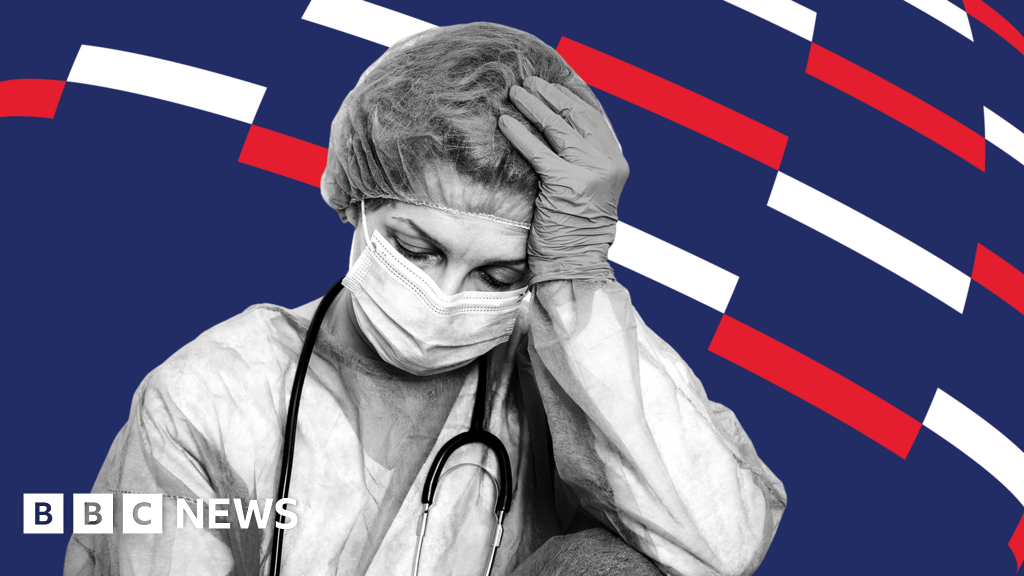
For Dr Bradley, although, it’s something however. The world’s sole, everlasting physician, she spent years basically on name 24/7.
Operating the hospital and the overall practitioner (GP) clinic, life was a endless recreation of catch up. She’d do rounds on the wards earlier than, after and in between common appointments. Even on good days, lunch breaks had been usually a pipe dream. On dangerous days, a hospital emergency would blow up her already punishing schedule.
Burnt out, two years in the past she stop – and the thread holding collectively the remnants of the city’s healthcare system snapped.
Streaky Bay is on the forefront of a nationwide disaster: insufficient authorities funding is exacerbating a scarcity of vital healthcare employees like Dr Bradley; wait instances are ballooning; docs are starting to jot down their very own guidelines on charges, and prices to sufferers are skyrocketing.
A once-revered common healthcare system is crumbling at each stage, typically barely getting by on the sheer willpower of docs and native communities.
Because of this, increasingly more Australians, no matter the place they dwell, are delaying or going with out the care they want.
Well being has grow to be a defining difficulty for voters forward of the nation’s election on 3 Could, with each of Australia’s main events promising billions of {dollars} in further funding.
However specialists say the options being supplied up are band-aid fixes, whereas what is required are sweeping modifications to the best way the system is funded – reform for which there has to this point been an absence of political will.
Australians inform the BBC the nation is at a crossroads, and must resolve if common healthcare is value saving.
The cracks in a ‘nationwide treasure’
Healthcare was the very last thing on Renee Elliott’s thoughts when she moved to Streaky Bay – till the 40-year-old discovered a cancerous lump in her breast in 2019, and one other one 4 years later.
Seeing an area GP was the least of her issues. With the experience and remedy she wanted solely out there in Adelaide, about 500km away, Mrs Elliott has spent a whole lot of hours and tens of hundreds of {dollars} accessing life-saving care, all whereas elevating three boys and working a enterprise.
Although she has since clawed again a piece of the associated fee by means of authorities schemes, it made an already harrowing time that rather more draining: financially, emotionally and bodily.
“You are attempting to get higher… however having to juggle all that as effectively. It was very difficult.”
When Australia’s trendy well being system was born 4 many years in the past – underpinned by a public insurance coverage scheme referred to as Medicare – it was supposed to ensure reasonably priced and accessible high-quality care to individuals like Mrs Elliott as “a primary proper”.
Well being funding right here is advanced and shared between states and federal governments. However the scheme basically meant Australians might current their vivid inexperienced Medicare member card at a physician’s workplace or hospital, and Canberra can be despatched a invoice. It paid by means of rebates funded by taxes.
Sufferers would both obtain “bulk billed” – fully free – care, largely by means of the rising public system, or closely subsidised remedy by means of a personal healthcare sector providing extra advantages and option to those that needed them.
Medicare grew to become a nationwide treasure virtually immediately. It was hoped this arrange would mix the perfect components of the UK’s Nationwide Well being Service and the perfect of america’ system.
Quick ahead 40 years and lots of within the trade say we’re on monitor to finish up with the worst of each.
There isn’t a denying that healthcare in Australia remains to be miles forward of a lot of the world, significantly with regards to emergency care.
However the core of the disaster and key to this election is GP companies, or main care, largely supplied by personal clinics. There has traditionally been no use for public ones, with most GPs selecting to simply accept Medicare rebates as full fee.
That’s more and more unusual although, with docs saying these allowances have not stored up with the true value of delivering care. On the similar time, employees shortages, which persist regardless of efforts to recruit from abroad, create a shortage that solely drives up costs additional.
Based on authorities information, about 30% of sufferers should now pay a “hole payment” for an everyday physician’s appointment – on common A$40 (£19.25; $25.55) out of pocket.
However specialists suspect the true determine is increased: it is skewed by seniors and youngsters, who have a tendency to go to docs extra usually and nonetheless get pleasure from largely bulk-billed appointments. Plus there is a rising cohort of sufferers not captured by statistics, who merely do not go to the physician due to escalating charges.
Brisbane electrician Callum Bailey is one among them.
“Mum or my accomplice will pester and pester and pester… [but] I am such a giant ‘I am going to simply endure in silence’ individual as a result of it is very costly.”
And each greenback counts proper now, the 25-year-old says: “At my age, I most likely needs to be in my prime searching for housing… [but] even grocery buying is nuts.
“[I] simply cannot sustain.”
This can be a story James Gillespie stored listening to.
So his startup Cleanbill started asking the query: if the common Australian grownup walked right into a GP clinic, might they get a free, normal appointment?
This 12 months, they referred to as virtually all the nation’s estimated 7,000 GP clinics – solely a fifth of them would bulk invoice a brand new grownup affected person. In your entire state of Tasmania, for instance, they could not discover a single one.
The outcomes resonate with many Australians, he says: “It actually introduced it dwelling to them that, ‘Okay, it isn’t simply us. That is taking place nationwide’.”
And that is simply main care.
Public specialists are so uncommon and so overwhelmed – with wait instances usually far past protected ranges – that almost all sufferers are funnelled towards exorbitantly costly personal care. The identical goes for lots of non-emergency hospital remedies or dental work.
There are at present no caps on how a lot personal specialists, dentists or hospitals can cost and neither personal medical insurance nor slim Medicare rebates reliably provide substantial reduction.
Priced out of care
The BBC spoke to individuals throughout the nation who say the rising value of healthcare had left them counting on charities for meals, avoiding dental care for nearly a decade, or emptying their retirement financial savings to fund remedy.
Others are borrowing from their mother and father, taking out pay-day loans to purchase remedy, remortgaging their homes, or promoting their possessions.
Kimberley Grima usually lies awake at night time, calculating which of her three youngsters – who, like her, all have power diseases – can see their specialists. Her personal overdue well being checks and checks are barely an afterthought.
“They’re selections that you simply actually do not wish to should make,” the Aboriginal lady from New South Wales tells the BBC.
“However when push involves shove and you have not obtained the cash… you’ve got obtained no different choice. It is heart-breaking.”
One other lady tells the BBC that had she been in a position to afford well timed appointments, her a number of sclerosis, a degenerative neurological illness, would have been recognized, and slowed, faster.
“I used to be so disabled by the point I obtained a prognosis,” she says.
The individuals lacking out are typically those who want it essentially the most, specialists say.
“We now have way more care in more healthy, wealthier components of Australia than in poorer, sicker components of Australia,” Peter Breadon, from the Grattan Institute assume tank says.
All of this creates a vicious cycle which feeds much more strain again into an overwhelmed system, whereas entrenching drawback and fuelling mistrust.
Each single a type of points is extra acute within the areas.
Streaky Bay has lengthy farewelled the idea of reasonably priced healthcare, preventing as an alternative to protect entry to any in any respect.
It is why Dr Bradley lasted solely three months after quitting earlier than “guilt” drove her again to the apply.
“There is a connection that goes past simply being the GP… You might be a part of the neighborhood.
“I felt that I would let [them] down. Which was why I could not simply let go.”
She got here again to a much more sustainable three-day week within the GP clinic, with Streaky Bay compelled to wage a bidding struggle with different determined areas for expensive, fly-in-fly-out docs to fill within the gaps.
It is yet one more line on the tab for a city which has already invested a lot of its personal cash into propping up a healthcare system purported to be funded by state and personal funding.
“We do not need a gold service, however what we wish is an equitable service,” says Penny Williams, who helps run the neighborhood physique which owns the GP apply.
When the clinic was on the verge of closure, the city desperately rallied to purchase it. When it was struggling once more, the native council diverted funding from different areas to high up its coffers. And even nonetheless most traditional sufferers – until they’re seniors or youngsters – fork out about A$50 per appointment.
It means locals are paying for his or her care thrice over, Ms Williams says: by means of their Medicare taxes, council charges, after which out-of-pocket hole charges.
Who ought to foot the invoice?
“No-one would say that is the Australia that we wish, certainly,” Elizabeth Deveny, from the Customers Well being Discussion board of Australia, tells the BBC.
Like many rich nations, the nation is struggling to deal with a rising inhabitants which is, on common, getting older and sicker.
There is a small however rising cohort which says it’s time to let go of the notion of common healthcare, as we have identified it.
Many docs, a handful of economists, and a few conservative politicians have sought to redefine Medicare as a “security internet” for the nation’s most weak somewhat than as a scheme for all.
Well being economist Yuting Zhang argues free healthcare and common healthcare are various things.
The taxes the federal government collects for Medicare are already nowhere close to sufficient to help the system, she says, and the nation both must have some robust conversations about the way it will discover further funds, or settle for affordable charges for individuals who can afford them.
“There’s all the time a trade-off… You’ve got restricted sources, you must take into consideration how one can use them successfully and effectively.”
The unique promise of Medicare has been “undermined by many years of neglect”, the Australian Medical Affiliation’s Danielle McMullen says, and most Australians now settle for they should contribute to their very own care.
She says freezes to Medicare rebates – which had been overseen by each events between 2013 and 2017 and meant the funds did not even sustain with inflation – had been the final straw. Since then, many docs have been dipping into their very own pockets to assist these in want.
Each the Labor Celebration and the Liberal-Nationwide coalition settle for there’s a disaster, however blame one another for it.
Opposition chief Peter Dutton says his authorities will make investments A$9bn in well being, together with funds for further subsided psychological well being appointments and for regional universities coaching key employees.
“Well being has grow to be one other sufferer of Labor’s value of residing disaster… we all know it has actually by no means been tougher or costlier to see a GP than it’s proper now,” well being spokesperson Anne Ruston advised the BBC in a press release.
On the opposite facet, Albanese – whipping out his Medicare card virtually each day – has sought to remind voters that Labor created the beloved system, whereas stating the Coalition’s beforehand combined help of the common scheme and the spending cuts Dutton proposed as Well being Minister a decade in the past.
“At this election, this little card right here, your Medicare card, is what’s at stake,” Albanese has mentioned.
His authorities has began fixing issues already, he argues, and has pledged an additional A$8.5bn for coaching extra GPs, constructing further public clinics, and subsidising extra medicines.
However the headline of their rescue packages is a rise to Medicare rebates and larger bonuses for docs who bulk invoice.
Proposed by Labor, then matched by the Coalition, the modifications will make it potential for 9 out of 10 Australians to see a GP without cost, the events declare.
One Tasmanian physician tells the BBC it’s only a “good election sound chunk”. He and lots of different clinicians say the additional cash remains to be not sufficient, significantly for the longer consults increasingly more sufferers are in search of for advanced points.
Labor has little endurance for these criticisms, citing analysis which they declare exhibits their proposal will depart the majority of docs higher off and accusing them of wanting funding “with out strings hooked up”.
However most of the sufferers the BBC spoke to are sceptical both events’ proposals will make an enormous distinction.
There’s way more they have to be doing, they are saying, rattling off a want checklist: extra work on coaching and retaining rural docs; efficient regulation of personal charges and extra funding in public specialist clinics; common bulk billing of youngsters for all medical and dental bills; extra funding for allied well being and prevention.
Specialists like Mr Breadon say, above all else, the best way Medicare pays clinicians must be overhauled to maintain healthcare entry genuinely common.
That’s, the federal government must cease paying docs a set quantity per appointment, and provides them a price range primarily based on how giant and sick the populations they serve are – that’s one thing a number of current evaluations have mentioned.
And the longer governments wait to put money into these reforms, the extra they are going to value.
“The celebrities could also be aligning now… It’s time for these modifications, and delaying them can be actually harmful,” Mr Breadon says.
In Streaky Bay although, locals like Ms Williams surprise if it is too late. Issues are already harmful right here.
“Possibly that is the cynic in me,” she says, shaking her head.
“The definition of common is everybody will get the identical, however we all know that is not true already.”