Enterprise reporter
As US President Donald Trump laid out tariffs on nearly each one in all America’s buying and selling companions on Wednesday, he had sturdy phrases for Beijing.
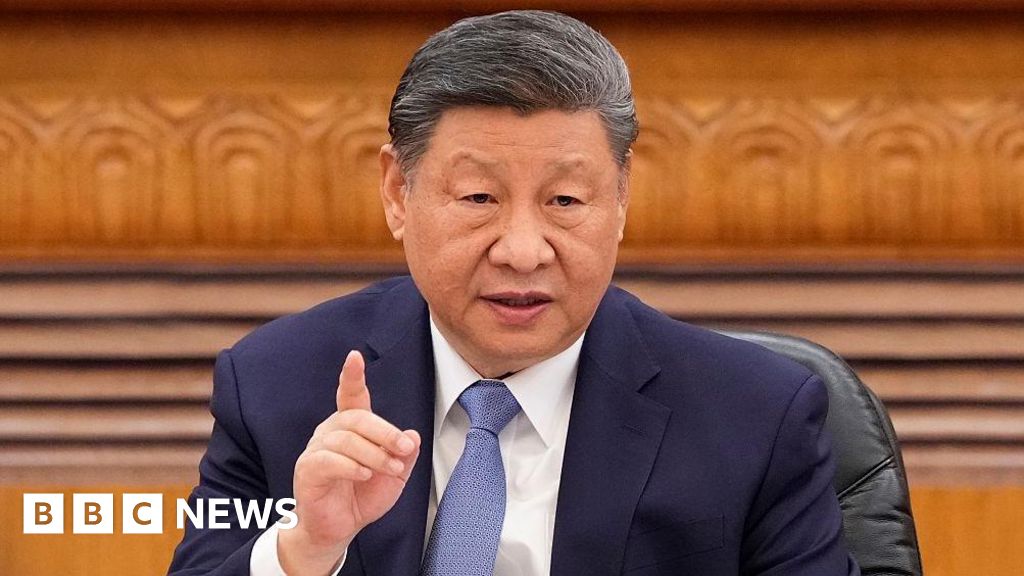
“I’ve nice respect for President Xi [Jinping] of China, nice respect for China, however they have been taking super benefit of us,” Trump mentioned throughout his roughly hour-long tackle Wednesday.
Holding up a chart itemizing nations and territories that he mentioned had put up commerce boundaries to US items, Trump mentioned: “In the event you have a look at that… China, first row, 67%. That is tariffs charged to the USA, together with forex manipulation and commerce boundaries.”
“We’re going to be charging [them] a reduced reciprocal tariff of 34%,” he added. “In different phrases, they cost us, we cost them, we cost them much less. So how can anyone be upset?”
However China’s Commerce Ministry instantly referred to as the transfer “a typical act of unilateral bullying” and pledged to take “resolute countermeasures to safeguard its rights and pursuits”.
And state information company Xinhua accused Trump of “turning commerce into an over simplistic tit-for-tat sport”.
Consultants consider Beijing has good cause to be upset.
For one, the newest announcement is an add on to current tariffs of 20% on Chinese language items.
Secondly, by imposing heavy tariffs on different South East Asian nations together with Cambodia, Vietnam and Laos, it has ‘slammed the door shut’ on how China rejigged its provide chains to get across the tariffs imposed on Beijing throughout Trump’s first time period.
There have been 5 Asian nations within the 10 nations and territories hit with the best tariffs.
The taxes are including up for China
Trump has imposed new tariffs on Chinese language imports since returning to the White Home in January, ratcheting up levies to twenty%.
In lower than every week, these tariffs will bounce to 54%, other than on merchandise like automobiles, metal and aluminium, which will likely be subjected to decrease tariffs.
Beijing has additionally been on the receiving finish of different Trump commerce salvos.
Earlier on Wednesday, the President signed an govt order to finish a provision for low-value parcels from China.
This had allowed Chinese language e-commerce giants like Shein and Temu to ship packages with a retail worth of beneath $800 (£617) to the US, with out taxes and inspections.
Near 1.4 billion shipments entered the US beneath the supply within the final monetary yr, in response to customs knowledge.
The removing of the exemption might pressure some Chinese language corporations to go the additional value on to clients, making their items much less aggressive within the US.
When taken collectively, it is a worrying image for Beijing, mentioned Deborah Elms from the Hinrich Basis consultancy.
“I do not suppose the brand new tariffs are essentially geared toward China. However when america stacks tariffs on prime of one another, particularly in direction of China, the numbers turn into eye-watering fairly rapidly.”
“China and the Chinese language should retaliate. They aren’t going to have the ability to sit again and watch this,” she mentioned.
Provide chain hit
Trump additionally imposed heavy tariffs, starting from 46% to 49%, on Vietnam, Laos and Cambodia.
This represents “a full-frontal assault on Beijing’s prolonged provide chain,” mentioned Stephen Innes from funding agency SPI Asset Administration.
“Vietnam… and others within the periphery are collateral injury in what’s shaping as much as be probably the most aggressive realignment of US commerce coverage in a era,” he added. “This is not tit-for-tat – it is strategic containment through tariff warfare.”
Laos and Cambodia, that are among the many poorest nations within the area, are closely dependant on Chinese language funding in provide chain infrastructure. The excessive tariff charges are anticipated to hit each nations laborious.
China is Vietnam’s largest buying and selling associate. It was one of many key beneficiaries of US-China tensions throughout Trump’s first time period.
In 2018, Trump hit China with tariffs, inflicting some companies to rethink the place they made their merchandise. Some selected to shift manufacturing to Vietnam.
This has led to a rise of exports from Vietnam to the US, with Chinese language firms which have moved manufacturing to there contributing to that determine.
“Vietnam was clearly focused [by Trump] resulting from its position as a conduit for China’s circumvention of earlier tariffs”, former US commerce negotiator Stephen Olson instructed the BBC.
Whereas the US stays Vietnam’s greatest export market, China is its largest provider of products, accounting for greater than a 3rd of imports, in response to the newest official knowledge.
Chinese language corporations have been additionally behind almost one in each three new investments in Vietnam final yr.
Pushan Dutt, a professor on the INSEAD enterprise college, mentioned the brand new taxes on South East Asia will likely be “prohibitive” for China.
“China has an issue with demand and within the final Trump administration their corporations had nimbly reacted to tariffs by rejigging provide chains and shifting them to [South East Asian Nations]. This door has been slammed shut,” he added.
However Trump’s taxes on the area may even affect US firms that manufacture items in South East Asia.
As an illustration, American companies together with know-how giants Apple and Intel, and sportswear big Nike have massive factories in Vietnam.
A latest survey by the American Chamber of Commerce in Vietnam discovered that the majority US producers there anticipate to put off employees if tariffs are imposed.
‘Onerous decisions’ forward
There’s the query of what China can do to reply to the brand new tariffs, given it solely has days earlier than they’re resulting from take impact.
Mr Olson mentioned he expects Beijing to have a “forceful” response with tariffs and different measures making it tougher for US firms to function in China.
With the Chinese language economic system already going through challenges, Beijing faces “powerful decisions” within the days forward, mentioned Professor Dutt.
“Exporting to different areas threatens de-industrialisation in these locations – and political leaders there are unlikely to just accept this. Meaning China has to lastly unleash home demand and the Chinese language family,” he added.
The tariffs might additionally push China to try to construct alliances with different Asian nations who’ve been on the receiving finish of the tariffs.
Wang Huiyao, a former China Communist Occasion member who works with the Middle for China and Globalisation suppose tank, referred to as on Asian nations to “work collectively to undergo this tough time and combat protectionism”.
“Ultimately, the US may very well be shedding all of the affect and isolate itself,” he added.
Some discussions are already underway. China, South Korea and Japan not too long ago held its first financial talks in 5 years.
They agreed to hurry up talks without spending a dime commerce settlement – which was first proposed over a decade in the past.
The brand new tariffs might give them added incentive to take action.
Nonetheless, Beijing might face some short-term ache whereas talks with Washington take its course.
“Finally, the US and China are headed for a negotiating desk the place they’re going to attempt to attain some sort of a grand cut price on a variety of points,” Mr Olson mentioned.
“That will not essentially occur quickly and I anticipate issues to worsen earlier than they get higher,” he added.