 Getty Photos
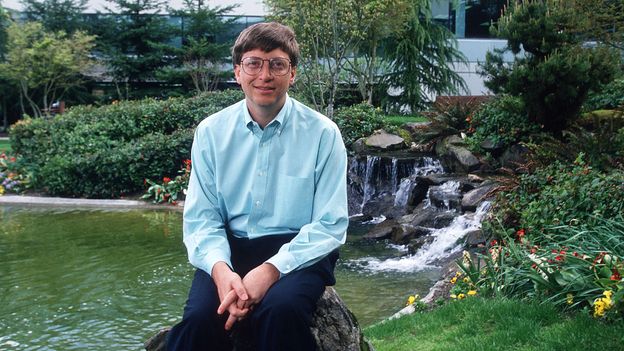
Gates and Paul Allen launched computing large Microsoft 50 years in the past. In 1993, he talked to the BBC in regards to the on-line improvements that might outline the twenty first Century.
When the BBC first broadcast an interview with Microsoft co-founder Invoice Gates in June 1993, there have been regarded as solely 130 web sites in complete. The BBC’s venerable science programme Horizon was investigating the brand new “Digital Frontier”, in an period the place “data is beginning to redefine our world, its geography and its economic system”. Gates instructed the programme: “That is the data age, and the pc is the device of the data age and software program is what’s going to decide how simply we are able to get in any respect of that data.” Viewers might ship off a cheque for £2 and obtain a transcript of the programme within the publish.
The pc business had already grown quicker than any in historical past, however the important thing to future earnings was creating one thing moveable and user-friendly. The programme requested: “Do we’d like countless data, or do they simply must promote it to us?” In a world the place a listing of just about each web site might match on two sides of a sheet of paper, the world large net didn’t even get a point out. Nevertheless, the concepts explored within the programme are sometimes far forward of their time.
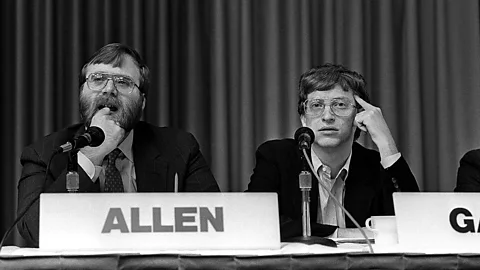
Within the early days of Microsoft, Invoice Gates and Paul Allen set a objective of getting a pc on each desk and in each dwelling – all working Microsoft merchandise, after all. They first met as youngsters at a non-public faculty in Seattle, the place they found a shared love of computer systems. Each went on to varsity however dropped out and created Microsoft, so-called as a result of it offered microcomputer software program.
The corporate’s large break got here in 1980 when Microsoft agreed to supply the working system for the private pc being developed by IBM, the world’s main pc firm on the time. In a stroke of enterprise genius, Microsoft was allowed to license the working system to different producers, spawning an business of “IBM-compatible” private computer systems which relied on its MS-DOS product. The cash had begun to roll in – and to at the present time it has not but stopped.
Whereas Gates was the serious-minded pc nerd, Allen was his offbeat large brother. Allen labored at Microsoft till 1983, stepping away from the frontline following a prognosis of blood most cancers. He recovered to change into a profitable enterprise capitalist and, having held onto his share of the corporate, he was a fixture on the world’s wealthy lists till his loss of life in 2018 on the age of 65. He used his huge fortune to put money into his private passions, proudly owning each the Portland Path Blazers basketball staff and Seattle Seahawks NFL staff, who gained the Tremendous Bowl in 2013.
His departure from Microsoft additionally meant that he had extra time to excellent his guitar strikes. Legendary music producer Quincy Jones even claimed in a journal interview that Allen “sings and performs identical to Hendrix”. He stated: “I went on a visit on his yacht, and he had David Crosby, Joe Walsh, Sean Lennon… then on the final two days, Stevie Surprise got here on along with his band and made Paul come up and play with him – he is good, man.” The design of Seattle’s Museum of Pop Tradition, which he based, has been likened to a smashed guitar and was created by celebrity architect Frank Gehry.

 Getty Photos
Allen jumped ship from Microsoft earlier than merchandise akin to Home windows, Excel and Phrase ever made it into the world’s houses and workplaces. By the early Nineteen Nineties, Gates’ imaginative and prescient for networked computer systems despatched gross sales and earnings hovering. Nevertheless, the pair’s early dream of placing a pc working Microsoft software program in each dwelling and enterprise was solely half full. Phrase processing and spreadsheets have been profitable, however Microsoft’s relentless drive to broaden wanted new worlds to discover. The subsequent step was to convey multimedia into folks’s houses, turning the private pc right into a communication machine. It was the world of leisure so beloved by Allen that Gates wanted to faucet into.
1,000 TV channels, and nothin’ on
Gates acknowledged to the BBC in 1993 that “the house will probably be a more durable frontier to overcome”. Nevertheless, he was assured that Microsoft would succeed. “In case you take a time-frame like 15 years or definitely 20 years, I’ve little question that the imaginative and prescient of a pc in each dwelling, though it will not appear like in the present day’s pc, will completely be achieved,” he stated.
A 12 months earlier, Bruce Springsteen had a hit grumbling about having “57 Channels (And Nothin’ On)”. Undeterred by the Boss’s cynicism, Microsoft’s Nathan Myhrvold talked of a future the place we’d have as much as 1,000 tv channels. He stated: “That may sound like a nightmare, however I believe it is a fantastic factor. Think about what your favorite bookstore can be like if there have been solely 5 books.” Describing a system resembling in the present day’s streaming providers, he spoke of an “on-line interactive information, which makes use of pc know-how to organise the channels, present them to you by subject, even study of the fabric that you just like to look at, after which current it to you in an internet trend proper on the tv”.
Myhrvold was offering a tantalising glimpse of the long run: a world at your fingertips the place you possibly can order an En Vogue CD or Prince tickets immediately. However what would this imply for private privateness?
There was a warning within the 1993 programme from Denise Caruso, editor of the journal Digital Media: “The convenience of sitting in entrance of your interactive TV 5 years therefore and having the ability to order one thing by pushing your distant management means details about you goes by means of a community. That signifies that whoever is on the opposite finish of that community is aware of what you are watching on tv, can get your bank card quantity, can know numerous issues about you that possibly you don’t need them to know.”
Caruso raised points echoed within the present debate about Generative AI fashions being educated by devouring copyrighted materials. She stated: “By making data a commodity, you actually change the character of how folks take into consideration concepts and their work and what they do. I’m a author. My inventory in commerce is concepts, and whenever you attempt to attract strains round what data is and the place did an thought come from and who had that concept initially and what serviette was it initially drawn on, whenever you begin transferring data into that realm, it begins to get very fuzzy about the place one particular person’s thought stops and one other one begins.”
She stated that whereas data was an unbelievable commodity, it had no worth in any respect except it might be protected. However how might you shield one thing that has no bodily existence and might be copied or modified undetectably?
“The issue is that the options are as complicated as the issues themselves. Do you wish to lock up all the data? Completely not. We might haven’t any scientific progress if scientists weren’t in a position to freely change concepts and data. Do you simply have a free-for-all and say all data is free? Properly, you’ll be able to’t do this both as a result of folks do really make their livings upon the fruit of their work, [which] is data, whether or not it is a ebook or it is a film or it is music. I believe know-how is an unbelievable factor and it’s totally highly effective, nevertheless it’s highly effective in each methods, and it is essential that all of us perceive that earlier than we simply embrace it.”
The beginning of electronic mail
Whereas the world large net didn’t characteristic within the programme, it was many viewers’ first introduction to the idea of email correspondence, or electronic mail. As Microsoft continued its voracious enlargement, the corporate’s human assets vice-president Mike Murray stated that electronic mail “creates an digital village [which] permits us to transcend the borders of time or geographic limitations”. His phrases could appear grandiose now, however on the time it might have been a revolutionary concept that one might talk immediately with somebody or many individuals on the opposite aspect of the world with out the necessity for an costly worldwide telephone name.
By the top of 1993, the variety of web sites was estimated at 623, having doubled each three months. By the top of 1994, the determine was 10,022. Microsoft was seen by some commentators as being sluggish to acknowledge the chances and progress of the net, however in Could 1995 Gates despatched a memo to his senior workers titled “The Web Tidal Wave”, calling it “an important single growth to return alongside for the reason that IBM PC was launched in 1981”. Three months later, Microsoft launched its net portal MSN alongside the discharge of Home windows 95. Some variations had its brand-new Web Explorer browser controversially bundled in. The longer term was once more up for grabs, and Gates as soon as once more had some large ideas on how he may conquer it.
For extra tales and never-before-published radio scripts to your inbox, signal as much as the In Historical past e-newsletter, whereas The Important Checklist delivers a handpicked number of options and insights twice every week.